

Chiral effective field theory (ChiEFT)#
Chiral effective field theory (ChiEFT) provides theoretical constraints on the equation of state of nuclear matter at low densities, through a systematic expansion of the nuclear many-body Hamiltonian in terms of low-energy degrees of freedom (nucleons and pions).
The expansion is truncated at a certain order, and the Hamiltonian can be solved numerically.
The theoretical uncertainties in the expansion can be estimated systematically, and the output is an uncertainty band \([p_-, p_+]\) for the pressure as a function of energy density, which can be used to constrain the EOS parameters in Bayesian inference, in the low-density region (up to \(2n_{\rm{sat}}\)).
For the details of the precise calculations of the chiEFT constraint used in jester, we refer to the discussion in [1].
Here, we limit ourselves to how the likelihood function is implemented in jester and how it can be used in practice.
The likelihood is implemented by the class jesterTOV.inference.likelihoods.chieft.ChiEFTLikelihood, which takes as input two files low_filename and high_filename containing the lower and upper bounds of the chiEFT constraint, respectively, as described above.
By default, jester loads the pressure bounds from [1], but users can also provide their own files with different chiEFT constraints if they wish.
With these bounds loaded, the likelihood function of a particular EOS, which predicts a pressure \(p(\theta_{\rm{EOS}} ; n)\) at a given density \(n\), is defined by
where the integration is terminated at the density \(n_{\rm{break}}\) where the chiEFT prediction breaks down. This means that the likelihood can only be evaluated for EOSs that either freely sample this parameter, or fix it otherwise.
Here, the function \(f(p, n)\) is a score function used to smoothly taper off the likelihood function around the chiEFT bounds, and is defined as (see arXiv:2402.04172v3, Sec. III A for details)
where \(p_-(n)\) and \(p_+(n)\) are the lower and upper bounds of the chiEFT constraint at density \(n\), respectively, and \(\sigma(n)\) is a smoothing parameter that controls how quickly the likelihood tapers off around the bounds.
Following [1], we set \(\beta = 6\) in jester, so that 75% of the weight is contained within the interval \([p_-, p_+]\), and the likelihood tapers off smoothly outside of this interval.
Note that the lower bound of the integration in Eq. (1) is set to \(0.75 n_{\rm{sat}}\), which is chosen somewhat arbitrarily, but this choice has been found to not impact the EOS inference.
The pressure bounds, as well as a visualization of the score function, is shown below (which mimics Fig. 2 in [1]):
(Source code, png, hires.png, pdf)
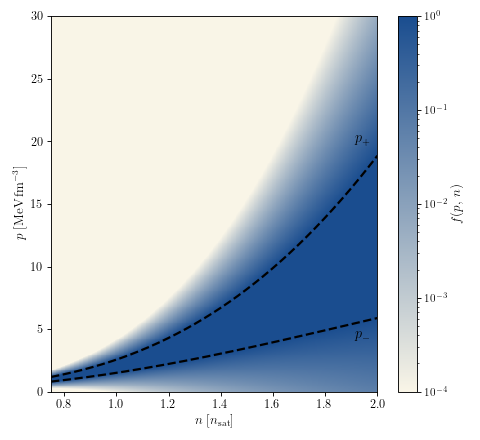
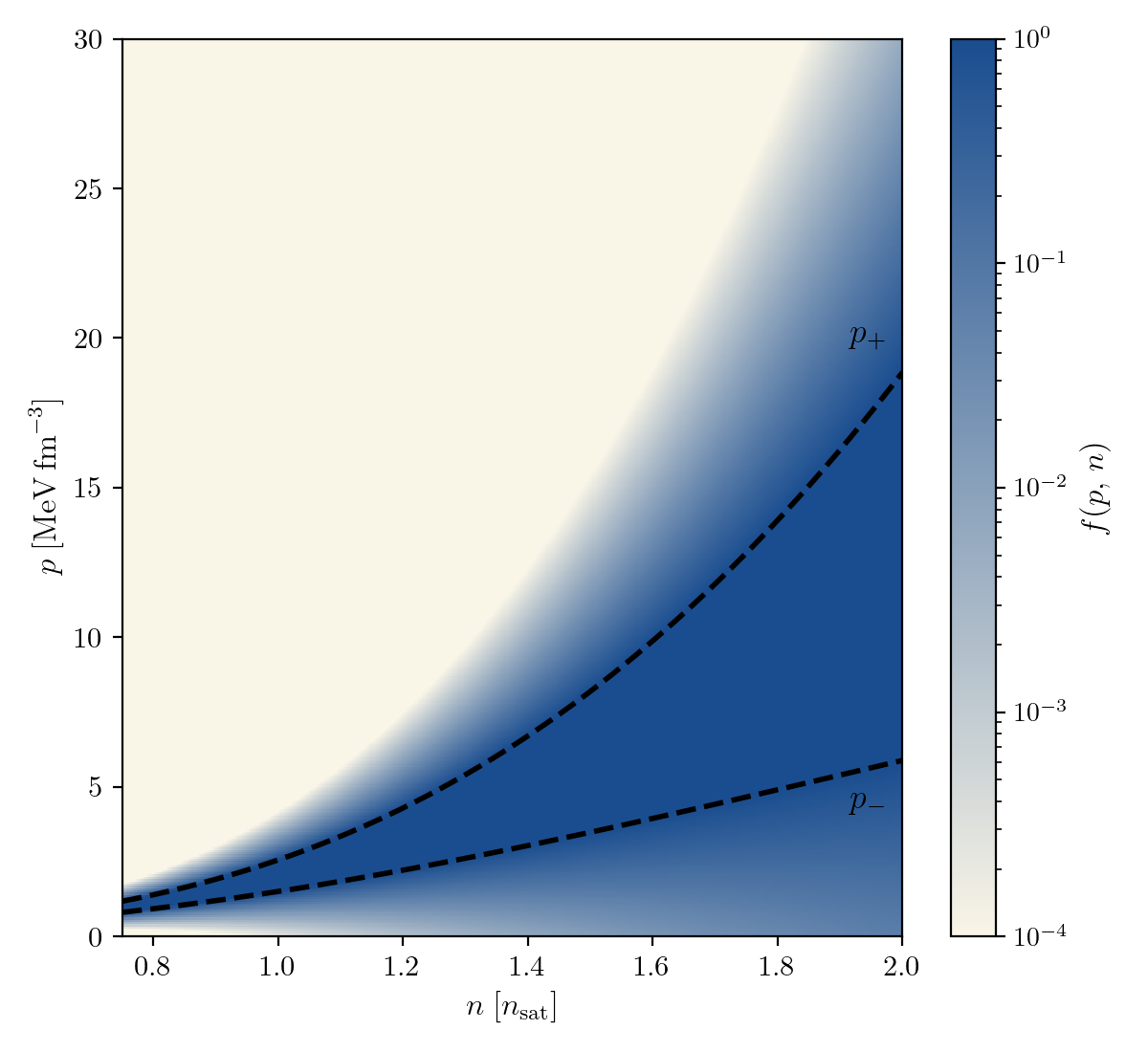
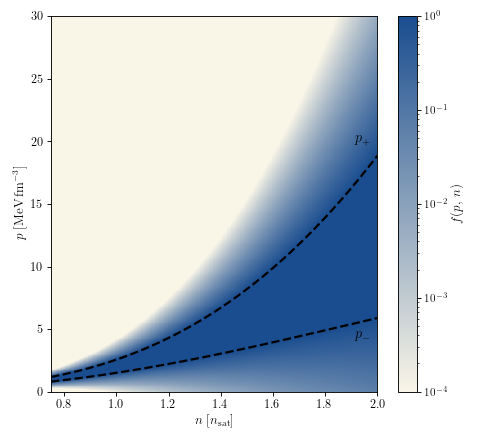
Score function \(f(p, n)\) as a function of pressure \(p\) and density \(n\). Dashed lines show the chiEFT band boundaries \(p_-\) (lower) and \(p_+\) (upper) from [1]. Inside the band \(f = 1\); outside it decays exponentially with slope \(\beta = 6\).#
Further resources#
API reference:
jesterTOV.inference.likelihoods.chieft.ChiEFTLikelihoodConfig class for usage in Bayesian inference workflows:
jesterTOV.inference.config.schemas.likelihoods.ChiEFTLikelihoodConfig
References
Hauke Koehn and others. From existing and new nuclear and astrophysical constraints to stringent limits on the equation of state of neutron-rich dense matter. Phys. Rev. X, 15(2):021014, 2025. arXiv:2402.04172, doi:10.1103/PhysRevX.15.021014.